

Painless Delivery refers to a childbirth process where labor pain is significantly reduced or made almost negligible using medical interventions, allowing the mother to deliver the baby normally without experiencing agonizing pain. In medical terminology, this is most commonly achieved through a technique called Epidural Analgesia or an Epidural.
Most ovarian cysts are natural and disappear on their own without causing any harm. However, some cysts can cause complications if they grow larger.
1. How Does a Painless Delivery Work?
An epidural does not involve surgery; it is a specialized method of blocking pain signals during natural vaginal delivery:
- When active labor begins and the cervix is dilated to about 3 to 4 centimeters, a specialized doctor called an Anesthetist is called.
- The mother is asked to either sit up and arch her back or lie on her side curled up. The lower back area is cleaned and numbed with a local anesthetic.
- A small needle is carefully inserted into the epidural space (the area just outside the membrane protecting the spinal cord) in the lower back.
- A tiny, flexible plastic tube called an epidural catheter is threaded through the needle, and the needle is then removed. The catheter remains taped securely to the back.
- Pain-relieving medications (local anesthetics or analgesics) are administered through this catheter. These drugs numb the pelvic nerves, blocking pain signals from the uterus and cervix from reaching the brain.
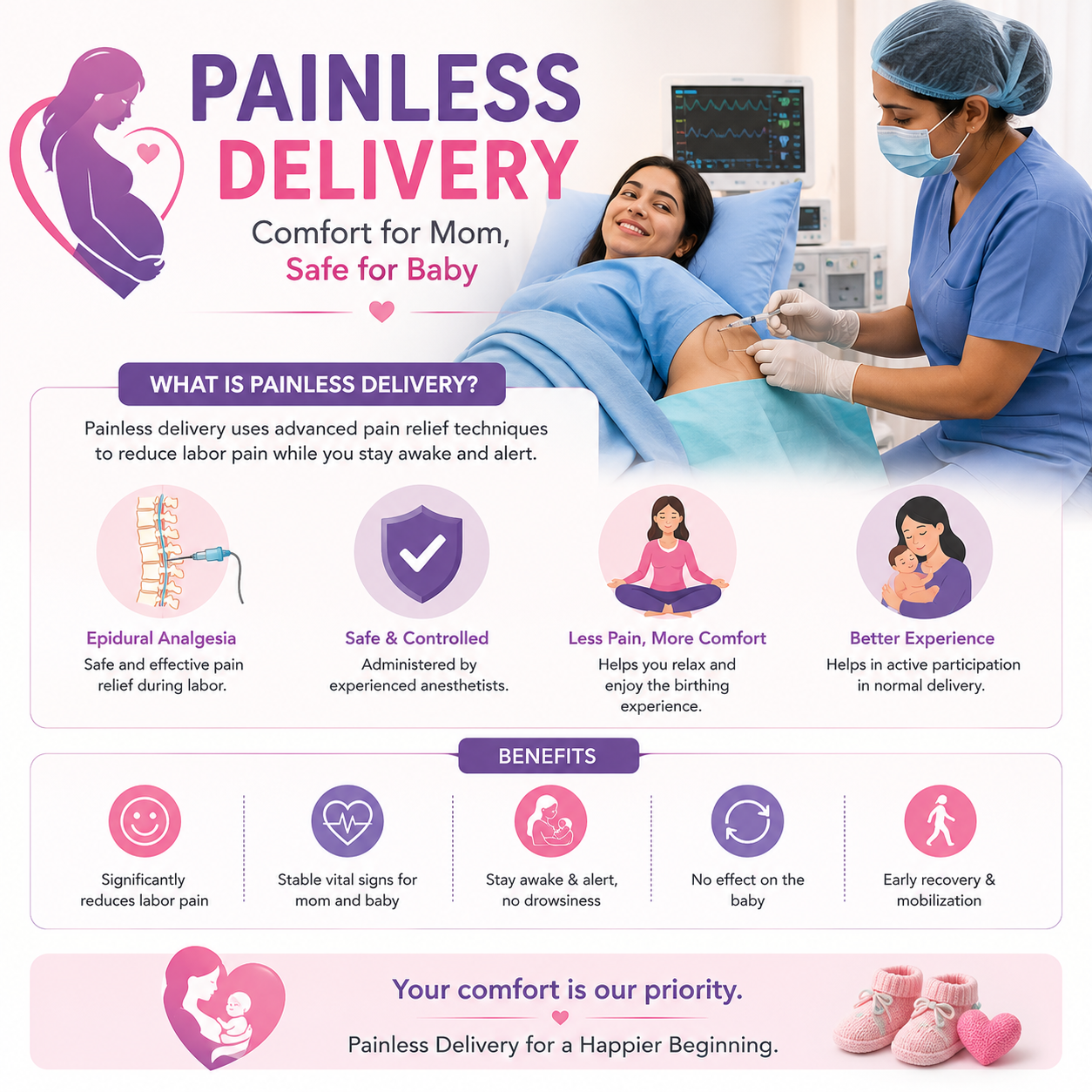
2. Key Benefits of Painless Delivery (Epidural)
- Excellent Pain Relief: The primary benefit is that it dramatically alleviates the severe pain of labor contractions. The mother remains completely awake, alert, and conscious of the birth process, but without the physical agony.
- Controls Blood Pressure: Severe pain and anxiety can cause a sharp spike in a mother’s blood pressure (BP). By eliminating pain, an epidural helps keep the mother’s blood pressure and heart rate stable.
- Reduces Exhaustion and Unplanned C-Sections: Prolonged labor pain can completely exhaust the mother, leaving her with no strength to push during the final stage of delivery. This exhaustion sometimes forces doctors to perform an emergency Cesarean section. An epidural allows the mother to rest, conserve her energy, and push effectively when the time comes.
- Easy Transition if Surgery is Needed: If an unexpected complication arises during natural labor that requires an emergency C-section, the existing epidural catheter can be used to deliver stronger surgical anesthesia immediately, eliminating the need for a fresh injection or general anesthesia.
3. Myths vs. Reality
There are several widespread misconceptions regarding epidural injections:
- Myth 1: It causes permanent, lifelong back pain.
- Reality: There may be mild tenderness or a bruised feeling at the injection site for 1 to 2 days after delivery, but it does not cause chronic or permanent back pain. Post-pregnancy back pain is usually caused by the physical strain of carrying the baby’s weight, altered posture, or calcium and vitamin D deficiencies.
- Myth 2: The medication harms the baby.
- Reality: The drugs used in an epidural primarily act locally in the spinal space. Only a minuscule, completely safe amount enters the mother’s bloodstream, meaning it has no adverse effects on the baby’s health or development.
- Myth 3: You cannot have a normal delivery after an epidural.
- Reality: An epidural only blocks pain; it does not stop natural labor. While it can sometimes reduce the sensation of contractions—making it slightly harder for the mother to know exactly when to push—doctors can easily lower the medication dosage at the final stage or safely use vacuum assistance if needed.
4. Potential Side Effects
While highly safe, like any medical procedure, an epidural can have minor side effects:
- Drop in Blood Pressure: The medication can relax blood vessels, causing a sudden, temporary drop in the mother’s BP. This is closely monitored and instantly managed by the medical team using intravenous (IV) fluids or specific medications.
- Temporary Leg Weakness: The mother’s legs may feel heavy, numb, or tingling for a few hours until the medication wears off.
- Shivering or Itching: Some women experience mild skin itching or shivering as a reaction to the analgesic medications.
- Post-Epidural Headache: In rare cases (less than 1%), if the needle goes slightly deeper, it can cause a spinal fluid leak leading to a severe headache a day or two later, which is easily treatable.
Contraindications: An epidural cannot be given if the mother has a severe skin infection on her back, a blood-clotting disorder, is taking blood thinners, or has an abnormally low platelet count.
