
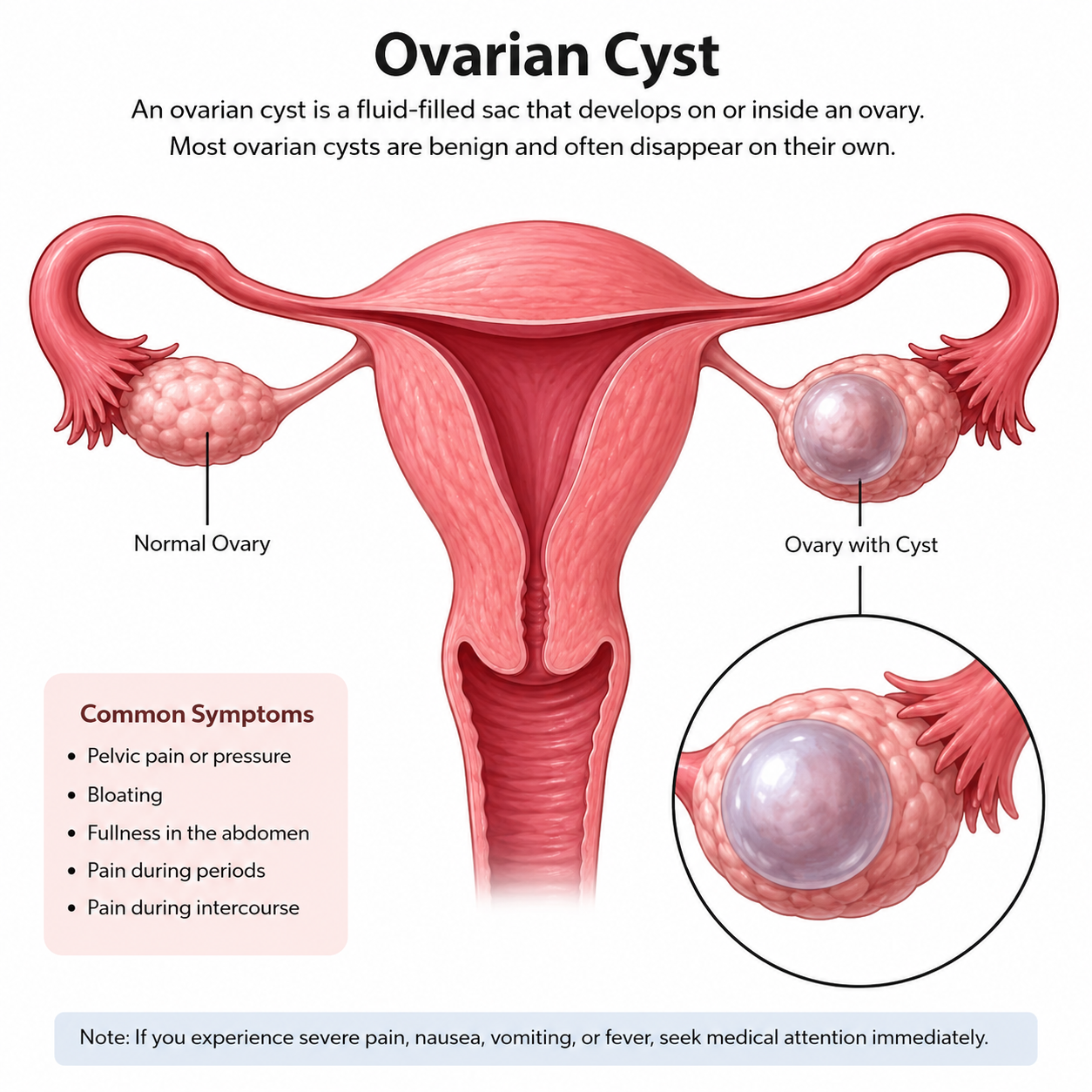
Ovarian Cyst means a tumor or water-filled sac in the ovary. In a woman’s body, there are two ovaries located on either side of the uterus, which produce eggs and female hormones. When a small sac-like structure filled with fluid develops inside or on the surface of these ovaries, it is called an ovarian cyst.
Most ovarian cysts are natural and disappear on their own without causing any harm. However, some cysts can cause complications if they grow larger.
Main Types of Ovarian Cysts
Ovarian cysts are mainly divided into two types:
A.Functional Cysts (The Common Type):
These are natural cysts formed during the menstrual cycle and are the most common.
- Follicular Cyst: During the menstrual cycle, an egg develops inside a small sac (follicle) in the ovary. Normally, this sac bursts and the egg is released. However, if this sac does not burst, it fills with fluid and becomes a cyst.
- Corpus Luteum Cyst: After the egg is released, the empty sac should ideally shrink. But if its opening gets sealed and it gets filled with blood or fluid, it is called a corpus luteum cyst.
B.Other Types of Cysts (Non-Functional):
- Dermoid Cyst: This tumor can contain tissues like skin, hair, teeth, or fat. These are formed from congenital cells and are mostly non-cancerous (benign).
- Endometriomas: This cyst forms when the inner lining of the uterus (endometrium) begins to grow on the ovaries. In common language, it is also called a ‘chocolate cyst’ because it is filled with old, brown blood.
- Cystadenomas: These develop on the outer surface of the ovary and are filled with a watery or mucous/gel-like fluid. They can grow quite large in size.
Symptoms of Ovarian Cysts
Most small cysts do not have any symptoms and are discovered incidentally during a sonography. However, if the cyst is large, the following symptoms may appear:
- Persistent or intermittent pain in the pelvic region (lower abdomen).
- Severe pain during menstruation or irregular periods.
- Heaviness, swelling, or bloating in the abdomen.
- Severe pain during sexual intercourse.
- Frequent urination or difficulty clearing bowels (if the large cyst presses against the urinary bladder or intestines).
Main Causes of Cysts
- Hormonal Imbalance: Disturbance in the levels of estrogen or progesterone hormones in the body.
- Pregnancy: A cyst forms naturally during the early months of pregnancy to support it until the placenta is formed.
- Endometriosis: Development of uterine tissues outside the uterus.
- Pelvic Infection: A severe infection in the pelvic region that can spread to the ovaries.
- PCOS/PCOD: Polycystic Ovarian Syndrome, where numerous small cysts (like a string of pearls) form in the ovaries.
Diagnosis and Treatment
Diagnosis:
The best and easiest medium to check for an ovarian cyst is a Pelvic Ultrasound (Sonography). In addition, if deemed necessary, a doctor may order a CA-125 Blood Test (to check for suspicion of cancer) or an MRI.
Treatment:
Not every ovarian cyst requires surgery. The treatment depends on the woman’s age, and the size and type of the cyst:
- Watchful Waiting (Observation): If the cyst is small (usually less than 5 cm) and functional, the doctor may advise waiting for 2–3 months and checking again with a follow-up ultrasound, as most of these sacs dissolve on their own.
- Medications: A doctor may prescribe oral contraceptive pills to balance hormones and prevent new cysts from forming.
- Surgery (Operation): If the cyst is very large (more than 5–6 cm), causes constant pain, or is a dermoid or chocolate cyst, it needs to be removed surgically. This operation is done in two ways:
- Laparoscopy (Keyhole Surgery): The cyst is removed by making small incisions on the abdomen. Recovery is faster in this method.
- Laparotomy (Open Surgery): If the tumor is very large or cancer is suspected, surgery is performed by making a larger incision on the abdomen.
Emergency Situation:
If sudden, severe, and sharp abdominal pain occurs, accompanied by dizziness, vomiting, or fever, it is necessary to reach a hospital immediately. These symptoms could be due to ‘Ovarian Torsion’ (twisting of the ovary) or a Cyst Rupture, both of which are medical emergencies.
